Meta Andromeda is Meta's AI-powered ad delivery system that uses deep learning to match ads with users based on thousands of behavioral signals, processing 10,000x more data per impression than the previous system. Launched in late 2024, Andromeda organizes ads into a hierarchical tree, clustering them by semantic similarity and social proof into what advertisers commonly call "Entity IDs." Ads that look or sound similar get clustered into a single Entity ID, meaning 50 ad variations might only get one ticket to the auction. Success requires creative diversity across format, persona, environment and benefit rather than high-volume testing of similar ads.
What Is Meta Andromeda?
Meta Andromeda is Meta's machine-learning retrieval engine that selects which ads to show you, built with NVIDIA to sift tens of millions of candidate ads in a few hundred milliseconds. In plain terms, it is the part of Meta's ad system that decides, the instant a page loads, which handful of ads out of millions actually get a chance to reach you.
What makes Andromeda matter to advertisers is the shift it represents. Older retrieval systems narrowed the pool with relatively coarse, rule-based logic before ranking. Andromeda uses a far larger deep-learning model to do the retrieval itself, so the system can consider vastly more ads and much subtler signals about each person before it ever gets to the auction. The result is that creative quality and clean account structure matter more than ever, because Andromeda is doing the heavy lifting of matching the right ad to the right person at retrieval time, not just at ranking time.
If you are a performance marketer, you likely know the old playbook: make 100 variations of your best ad, flood the system, and let the algorithm pick a winner.
That strategy is now dead. And it's not just "less effective"-it might be actively destroying your campaign performance.
In late 2024, Meta launched Andromeda, a new ad-serving system. Most people think it's just a "smarter algorithm." It isn't. It is a fundamental change to the architecture of how ads are selected, delivered, and ranked.
This guide explains the technical reality of Meta Andromeda - specifically the concept of "Entity IDs" - and why your current creative testing strategy is likely getting blocked at the gate.
The 300-Millisecond Problem: Why Meta Built Andromeda
To understand Meta Andromeda, you have to understand the engineering problem Meta faces.
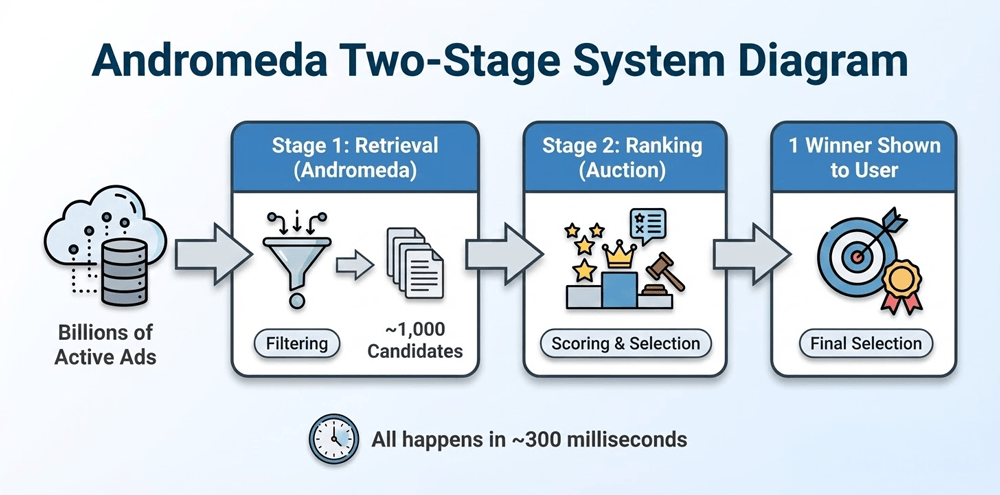
When a user opens Instagram or Facebook, Meta has roughly 300 milliseconds to decide which ad to show them. That's less than the blink of an eye. However, there are billions of active ads in the system at any given moment. Meta cannot possibly run a complex auction (Stage 2) for billions of ads in a fraction of a second. It would crash the servers.
The computational cost is staggering. Running a full ranking algorithm that calculates estimated action rates, predicted conversion probability, and eCPM for billions of ads would require processing power that simply doesn't exist at scale.
So Meta's engineering team split the ad delivery system into two distinct stages:
Stage 1: Retrieval (Andromeda) - The "Gatekeeper." Its job is to scan billions of ads and whittle them down to a manageable list of candidates (typically around 1,000 ads). This happens in milliseconds using a hierarchical tree structure based on user interests, ad characteristics, and semantic similarity.
Stage 2: Ranking (The Auction) - The sophisticated system you're familiar with. It calculates eCPM, predicted click-through rates, conversion probability, and competitive bids to pick the single winner from the 1,000 candidates that made it through Stage 1.
Here's the critical insight: Andromeda is the Stage 1 Retrieval system. It decides if you even get a ticket to the auction. If your ad doesn't make it past Andromeda's retrieval filter, it doesn't matter how good your targeting is, how high your bid is, or how compelling your creative is. You're not in the game.
The "Clustering" Trap: Why 50 Ads = 1 Ad
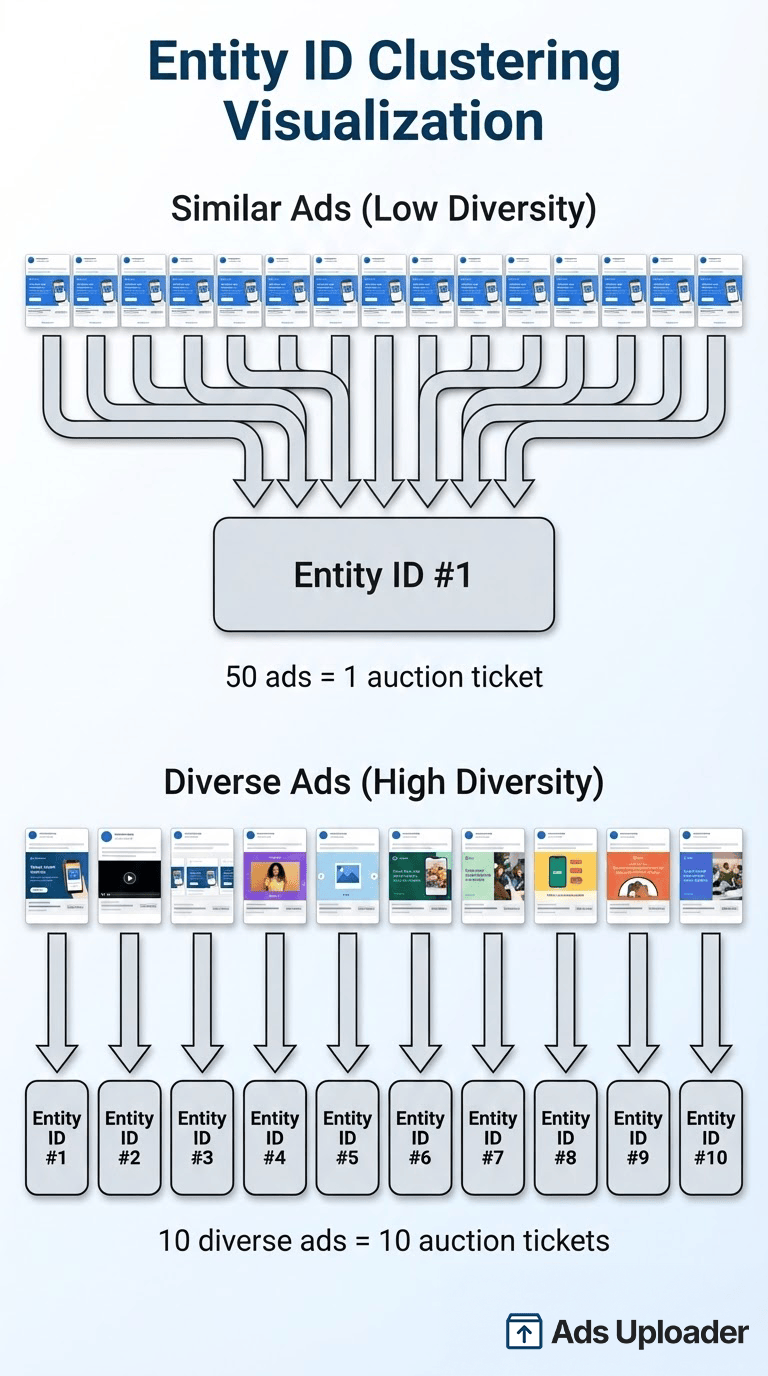
Here is the critical insight that most advertisers miss: Andromeda does not see your 50 ad variations as 50 different ads.
To process data quickly and efficiently, Andromeda organizes ads into a giant Hierarchical Tree based on "Social Proof" (engagement signals like likes, comments, shares) and semantic similarity (what the ad looks like, what it says, what it's selling).
It clusters ads that look similar, sound similar, or target similar personas into groups. Think of it like a filing system. If you upload 50 ads where you've only changed the headline color, swapped out a single word in the copy, or adjusted the background music, Andromeda scans them, realizes they are effectively the same concept, and clusters them together.
It then assigns that cluster a single Entity ID.
What Is an Entity ID?
"Entity ID" is the shorthand the industry uses to describe how Andromeda groups conceptually identical ads; it is an explanatory device for this clustering behavior rather than an official term Meta publishes. Think of it as a semantic fingerprint: not the same as your ad ID or campaign ID, but a way to picture how the system decides whether your ad is genuinely different from your other ads.
When Andromeda evaluates your ads, it uses computer vision to analyze visual elements, natural language processing to analyze copy, and audio analysis for video ads. If multiple ads score above a similarity threshold across these dimensions, they get collapsed into the same Entity ID.
The Consequence: One Entity ID = One Auction Ticket
If you have 50 ads but they are all clustered into 1 Entity ID, you only have one ticket to the Stage 2 auction.
You aren't flooding the system. You are bottlenecking yourself. You are doing 50x the work for 1x the opportunity.
To win in the Meta Andromeda era, your goal is no longer "Creative Volume." Your goal is maximizing Entity IDs - creating genuinely diverse ads that the system recognizes as conceptually distinct.
How Andromeda's Hierarchical Tree Works
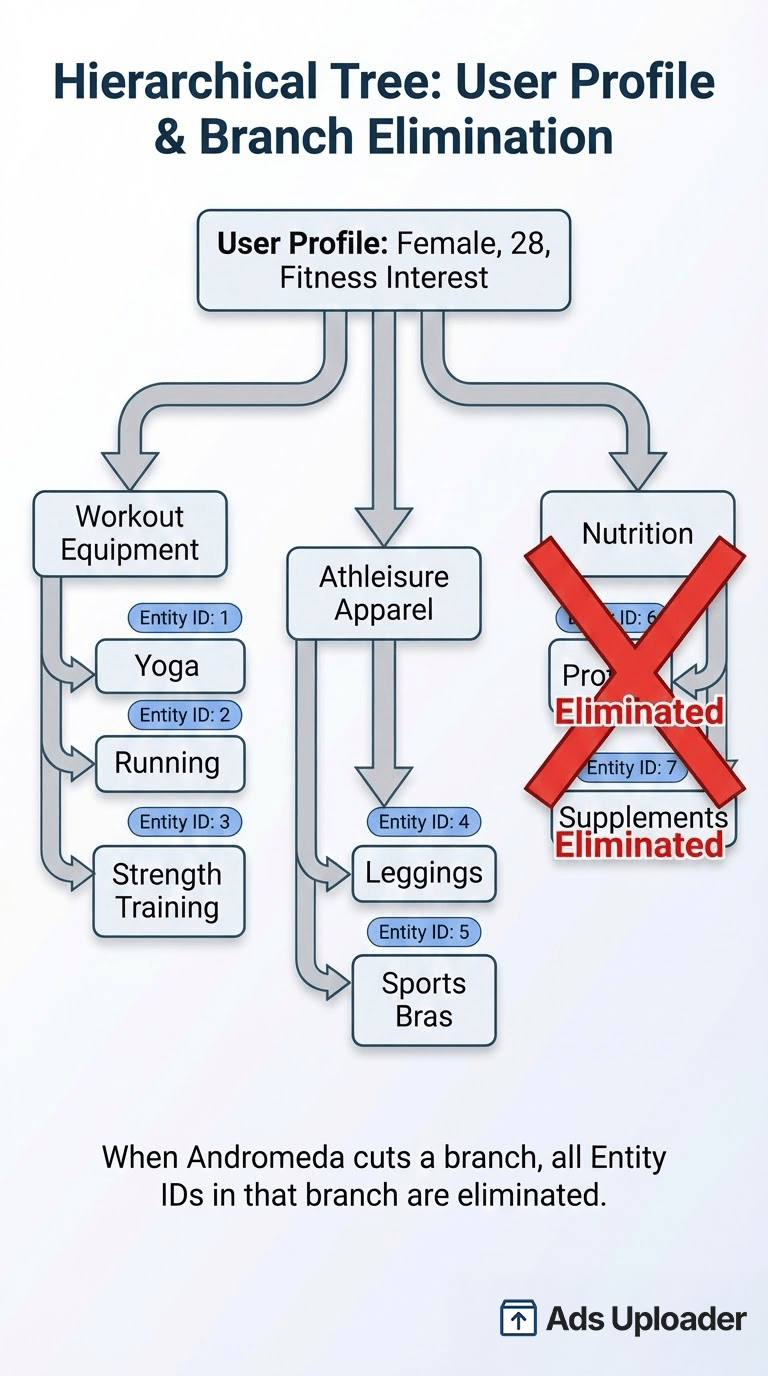
Since Andromeda uses a decision tree to filter ads based on user interest signals (e.g., User likes Shoes → Sports → Running), entire branches of the tree are eliminated instantly if they don't match the user's current intent.
Here's a simplified example of how the tree works:
User Profile: Female, 28, interested in fitness
└── Fitness Products
    ├── Workout Equipment
    │   ├── Yoga (Entity ID 1, 2, 3)
    │   ├── Running (Entity ID 4, 5)
    │   └── Strength Training (Entity ID 6)
    ├── Athleisure Apparel
    │   ├── Performance Leggings (Entity ID 7, 8)
    │   └── Sports Bras (Entity ID 9, 10)
    └── Nutrition
        ├── Protein Powder (Entity ID 11)
        └── Energy Supplements (Entity ID 12, 13)
If Meta Andromeda determines this user is currently in a "yoga" intent state based on recent behavior, it might cut the entire "Nutrition" branch from consideration. All your Entity IDs in that branch (11, 12, 13) don't even make it to the auction, no matter how well-optimized they are.
The Branch-Cutting Problem
If all your ads sit on one "branch" of that tree-because they all promote the same benefit, use the same visual style, or target the same persona-and Andromeda cuts that branch, none of your ads show.
This is why the old "100 minor variations" strategy fails. If all 100 variations are conceptually similar (same benefit, same audience, same visual style), they all sit on the same branch. When that branch is cut, you have zero presence in that auction.
To survive, you need ads that sit on different branches. You need to force the system to assign you multiple Entity IDs across multiple branches of the decision tree.
How Andromeda Actually Retrieves Ads
Mechanically, Andromeda runs as the retrieval stage that sits ahead of the auction. When an impression opportunity appears, Andromeda scores a massive candidate set and narrows tens of millions of ads down to a few thousand; only then does the familiar value-based auction (bid, estimated action rates, ad quality) rank that shortlist. Meta's own engineering team describes the core innovations as a custom deep neural network on NVIDIA Grace Hopper hardware plus a jointly-trained hierarchical index, which is what lets the system consider a far larger candidate pool than older retrieval allowed. Two things follow: niche and broad audiences both benefit (the system can find pockets of relevance it previously missed), and weak creative gets filtered earlier (it never makes the shortlist). This is why "let the system go broad with strong creative" is the dominant Andromeda-era strategy. When researching what strong creative looks like in your niche, find what is already winning in the Meta Ads Library, and a free browser tool like the Ad Library Helper extension (adlibraryhelper.com) makes it faster to spot the ads competitors are replicating most. Then make sure your structure and audience targeting give Andromeda the room to do its retrieval job.
How to Hack the Tree: Creating More Entity IDs
There are two specific ways to force Andromeda to assign you multiple Entity IDs: Thematic Variety and Visual Variety.
1. Thematic Variety (The "Persona" Pivot)
This creates new branches on the decision tree. Instead of making 10 ads about the same benefit, create ads that target fundamentally different pain points or motivations.
Example: Selling a Mattress
Don't just make 10 ads about "Comfort." Instead:
Ad Set A (Entity ID 1): Focus on "Back Pain Relief" (Medical angle)
- Copy emphasizes orthopedic support, spine alignment, pain reduction
- Visuals show back pain sufferers finding relief
- Targets health-conscious consumers
Ad Set B (Entity ID 2): Focus on "Temperature Regulation" (Comfort angle)
- Copy emphasizes cooling technology, sleeping hot solutions
- Visuals show comfortable sleep in cool environments
- Targets people who sleep hot
Ad Set C (Entity ID 3): Focus on "Partner Disturbance" (Relationship angle)
- Copy emphasizes motion isolation, undisturbed sleep
- Visuals show couples sleeping peacefully
- Targets people who share a bed
By targeting different pain points and personas, you force Andromeda to file these ads in different parts of the decision tree. If the "Back Pain" branch is cut for a particular user, your "Temperature Regulation" branch might still survive to the auction.
2. Visual Variety (The "Big Swing")
If you find a winning angle, do not just tweak the font or change the button color. That is a waste of time. Andromeda's computer vision will see it as the same ad, assign it the same Entity ID, and you'll end up with the same single auction ticket.
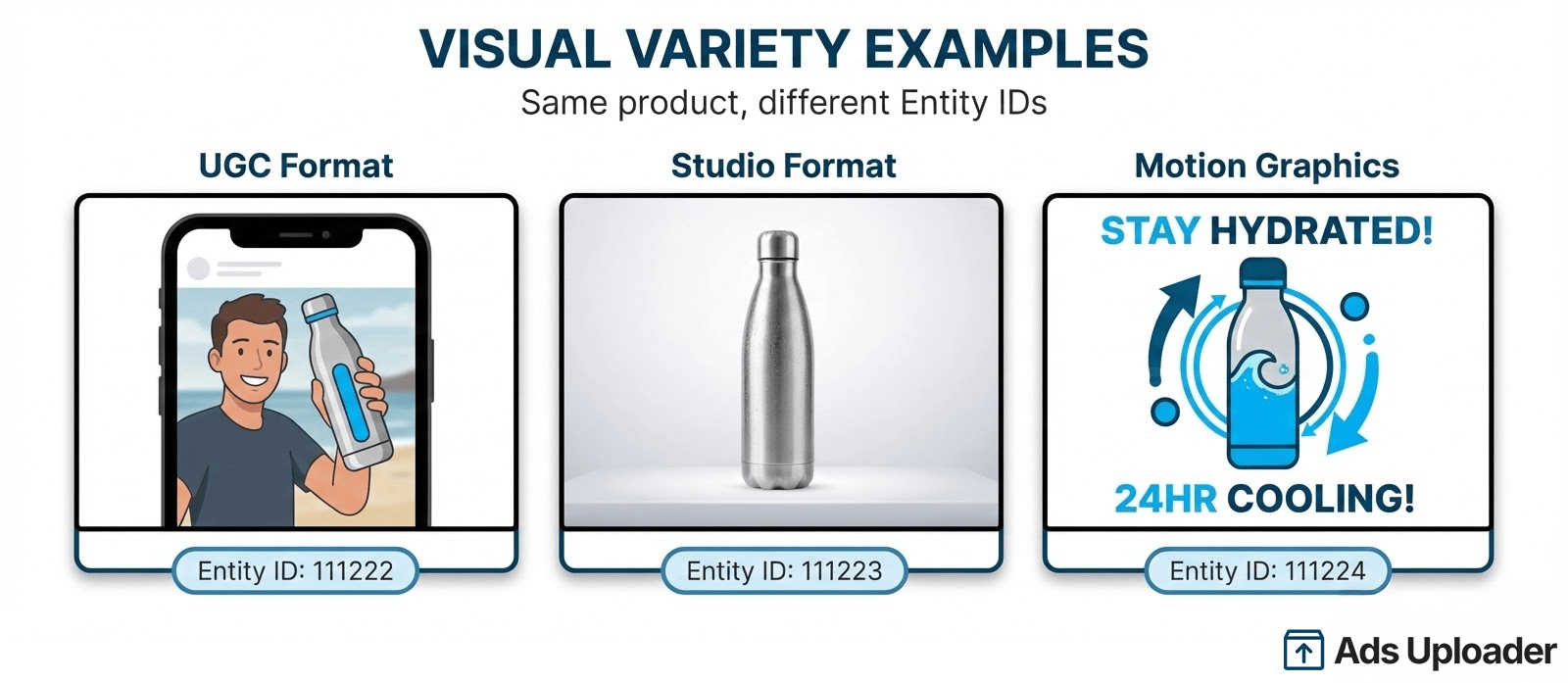
To get a new Entity ID on a winning angle, you need Visual Disparity - differences significant enough for Meta's computer vision to recognize them as distinct concepts.
Example: Same Benefit, Different Visual Execution
Variation 1: User Generated Content
- Selfie-style, handheld camera
- Real person speaking directly to camera
- Low production value, authentic feel
- Casual setting (bedroom, kitchen)
Variation 2: High-Production Studio Shot
- Professional cinematography
- Staged lighting, art direction
- Product showcased in idealized environment
- Polished, aspirational aesthetic
Variation 3: Text-Only Graphic Motion
- No human faces
- Animated text overlays on product shots
- Bold typography, kinetic motion
- Minimal, design-forward approach
These look different enough to Meta Andromeda's AI that they are less likely to be clustered into a single Entity ID, giving you more tickets to the auction - even though they're all communicating the same core benefit.
The New Strategy: The "Entity ID" Framework
The old strategy was: Narrow Targeting + High Volume of Similar Creatives
The Meta Andromeda strategy is: Broad Targeting + High Diversity of Entity IDs
Here is how to restructure your workflow to stop wasting money on "duplicate" ads that all collapse into the same Entity ID:
Restructuring this way means launching more genuinely distinct concepts, which is exactly the manual work that stalls teams. If you script your launches or hand them to an AI agent, our Meta Ads CLI pushes a diverse set live with the same defaults, guardrails, and validation as the app - or connect our Meta Ads MCP and have Claude or ChatGPT arrange the concepts in the build you have open in the web app.
Launch More. Click Less.
Upload hundreds of creatives at once, auto-match thumbnails to videos, and export directly to Meta Ads Manager.
Try Ads Uploader FreeNo credit card required • 7-day free trial
Step 1: Audit for "Fake Diversity"
Look at your active ads right now. If you stripped away the minor edits (font colors, slightly different hooks, background music swaps), how many truly unique concepts do you have?
If you have 20 ads running but they are all UGC videos of a woman holding your product in a kitchen, filmed in the same visual style, talking about the same benefit - you likely only have 1 active Entity ID.
You're not testing 20 concepts. You're testing 1 concept 20 times. That's not creative diversity. That's creative redundancy.
Audit Questions:
- If I showed these ads to someone without the copy, would they look like different ads?
- Are we targeting fundamentally different pain points or benefits?
- Are we using different visual formats (UGC vs. studio vs. motion graphics)?
- Are we speaking to different customer personas or use cases?
If the answer is "no" to most of these, you have fake diversity.
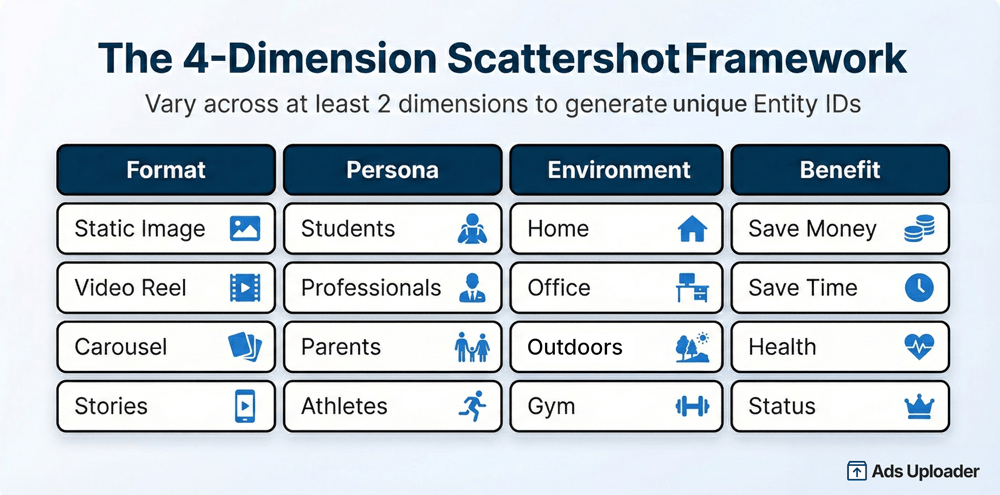
Step 2: The 4-Dimension Scattershot
To ensure you are generating unique Entity IDs, every batch of creatives must vary across at least two of these four dimensions:
Format: Static image vs. Video Reel vs. Carousel vs. Stories format
Persona: Student vs. Mom vs. Professional vs. Retiree vs. Athlete
Environment: Outdoors vs. Office vs. Home vs. Gym vs. Social setting
Benefit: Save Money vs. Save Time vs. Status/Identity vs. Health vs. Convenience
Example: Launching 12 Ads for a Productivity App
Instead of creating 12 variations of the same "saves you time" message with minor copy tweaks, create:
- 3 ads targeting "busy parents" (persona) showing "time savings" (benefit) in a "home environment" using video format
- 3 ads targeting "professionals" (persona) showing "career advancement" (benefit) in an "office environment" using carousel format
- 3 ads targeting "students" (persona) showing "better grades" (benefit) in a "study environment" using UGC video format
- 3 ads targeting "entrepreneurs" (persona) showing "scale your business" (benefit) in a "workspace environment" using static image format
Each group sits on a different branch of the Andromeda decision tree. Each generates its own Entity ID. You now have 4 genuine auction tickets instead of 1.
Step 3: Broad Targeting is Mandatory
This is the hardest mental shift for experienced media buyers, but it's critical in the Andromeda era.
Because Andromeda creates its own "Targeting Tree" based on your creative's semantic content, manual targeting (Interests, Lookalikes, Detailed Targeting) acts as a barrier. It prevents Andromeda from testing your ads on different branches of its decision tree.
Here's why: If you manually tell Meta "only show this to people interested in Yoga," but your creative semantically maps to "Running Shoes" in Andromeda's understanding, you've created a conflict. Andromeda will either ignore your manual targeting (wasting impressions) or skip your ad entirely because the branch doesn't match.
The Andromeda-era targeting strategy:
- Remove detailed interests
- Remove lookalike audiences
- Remove narrow demographic targeting
- Let the Creative (and the Entity ID) dictate the audience
Set your targeting as broad as possible-typically just Age and Gender if you have product restrictions, or completely open if you don't.
This feels counterintuitive if you've been running Meta ads for years. But Andromeda is fundamentally a creative-first system. The creative determines which branch of the tree your ad sits on. Manual targeting just limits which users Meta Andromeda can consider, reducing the number of auctions you're eligible for.
Real-World Example: E-commerce Brand Testing
Let's walk through a concrete example of how this works in practice.
Scenario: You're launching a new water bottle. In the old world, you might create 50 variations of your best-performing ad-tweaking headlines, button colors, opening hooks, and music.
Old Strategy (50 ads, 1 Entity ID):
- 50 variations of UGC video
- All shot in gym setting
- All featuring same spokesperson
- All emphasizing "hydration during workouts"
- Minor differences: opening line, CTA button text, background music
- Result: Andromeda clusters them into 1 Entity ID = 1 auction ticket
Andromeda Strategy (12 ads, 12 Entity IDs):
Persona 1: Fitness Enthusiasts (3 Entity IDs)
- UGC video: "Stays cold during HIIT workouts" (gym environment)
- Static image: Product shot with ice cubes (benefit: temperature)
- Carousel: Before/after hydration levels (benefit: performance)
Persona 2: Office Workers (3 Entity IDs)
- UGC video: "Keeps me hydrated at my desk" (office environment)
- Motion graphics: "8 glasses/day made easy" (benefit: health habits)
- Static testimonial: "No more afternoon crashes" (benefit: energy)
Persona 3: Parents (3 Entity IDs)
- UGC video: "My kids actually drink water now" (home environment)
- Carousel: Kid-friendly colors and sizes (benefit: family health)
- Static image: BPA-free, dishwasher safe (benefit: safety/convenience)
Persona 4: Outdoor Enthusiasts (3 Entity IDs)
- UGC video: "Survived my 10-mile hike" (outdoor environment)
- Static image: Product in nature setting (benefit: durability)
- Video: Leak-proof demonstration (benefit: reliability)
Result: 12 distinct Entity IDs across 4 different branches of the decision tree. Even if 2-3 branches get cut for certain users, you still have 6-9 ads competing in auctions.
The old strategy gave you 50 ads fighting for 1 auction slot. The new strategy gives you 12 ads fighting for 12 auction slots.
Common Mistakes (And How to Avoid Them)
Mistake 1: Confusing "Variations" with "Diversity"
What it looks like: Creating 30 versions of the same video with different opening hooks or text overlays.
Why it fails: Andromeda's computer vision analyzes the underlying visual content. If the video footage is 90% identical, it's the same Entity ID regardless of text changes.
Fix: Create fundamentally different video concepts, not just different intros to the same video.
Mistake 2: Testing Format Instead of Concept
What it looks like: Taking the same creative and exporting it as 1:1, 4:5, and 9:16 aspect ratios, counting them as "3 different ads."
Why it fails: Aspect ratio variations are critical for placement optimization, but they don't create new Entity IDs. Andromeda sees these as the same conceptual ad adapted for different placements.
Fix: Use aspect ratio variations within each Entity ID, but don't count them as separate concepts.
Mistake 3: Ignoring the Complexity Budget
What it looks like: Creating 100 genuinely diverse Entity IDs and launching them all at once.
Why it fails: Andromeda still has a learning phase. Fragmenting your budget across 100 Entity IDs means each one gets minimal data, none exit learning, and performance suffers.
Fix: Start with 10-15 diverse Entity IDs. Let them gather data for 7-14 days. Scale the winners, kill the losers, then introduce new concepts.
Mistake 4: Broad Targeting Without Creative Diversity
What it looks like: Setting targeting to "All ages, all genders" but only running 3 similar ads.
Why it fails: Broad targeting is only effective if you have enough Entity IDs to populate different branches of the decision tree. Without creative diversity, you're just showing the same ad to everyone.
Fix: Broad targeting requires creative diversity. Aim for minimum 10 Entity IDs across at least 3 different personas or benefits.
FAQ: Meta Andromeda
What is Meta Andromeda?
Meta Andromeda is the AI-powered retrieval system that acts as the first stage of ad delivery, filtering billions of ads down to roughly 1,000 candidates before the traditional auction ranking happens. It uses a hierarchical tree structure based on semantic similarity and user intent to determine which ads are eligible for the auction.
When did Meta launch Andromeda?
Meta launched Andromeda in late 2024 as part of a broader infrastructure upgrade to its ad delivery system. The rollout happened gradually across different ad accounts throughout Q4 2024 and Q1 2025.
Save Hours on Creative Testing
Stop uploading ads one by one. Bulk process unlimited creatives with automatic media matching and direct API publishing.
Try Ads Uploader FreeNo credit card required • 7-day free trial
Does Meta Andromeda replace manual targeting?
No, but it changes how manual targeting works. Andromeda builds its own semantic understanding of your ad's content and likely audience. If your manual targeting conflicts with Andromeda's understanding, it can reduce your ad's eligibility for auctions. This is why broad targeting strategies now outperform narrow interest-based targeting in most cases.
How many ad creatives do I need for Meta Andromeda?
Quality matters more than quantity. Instead of 100 similar variations (which might collapse into 1-3 Entity IDs), aim for 10-15 genuinely diverse concepts that generate unique Entity IDs. Each concept should vary across at least two dimensions: format, persona, environment, or benefit.
Will Meta Andromeda increase my ad costs?
Not inherently. Andromeda is a neutral system-it doesn't increase or decrease costs. However, if your strategy doesn't adapt (e.g., you're still using narrow targeting with low creative diversity), you might see worse performance because you're eligible for fewer auctions. Advertisers who adapt typically see improved performance and lower costs due to better auction efficiency.
Can I still use manual targeting with Andromeda?
Yes, but with diminishing returns. Andromeda performs best with broad targeting because it can place your ads in more branches of its decision tree. Narrow manual targeting limits which auctions you're eligible for, reducing the value of having multiple Entity IDs. For best results, use minimal targeting (Age/Gender if required) and let creative diversity do the work.
How long is the learning phase with Meta Andromeda?
The learning phase timeline hasn't changed significantly-still typically 7-14 days or 50 optimization events, whichever comes first. However, Andromeda may extend learning if you're running too many Entity IDs simultaneously with insufficient budget for each to gather meaningful data.
Does Meta Andromeda work for B2B advertising?
Yes, but B2B advertisers need to adapt their creative strategy just like B2C. The key difference: B2B Entity IDs should vary across job functions, pain points, and company sizes rather than consumer demographics. For example, create separate concepts for "IT Decision Makers" vs. "Marketing Leaders" vs. "Operations Managers" rather than 50 variations of the same "Enterprise Solution" message.
Can I see what audience Andromeda is targeting?
Not directly. Meta doesn't provide visibility into which branches of the Andromeda decision tree your ads occupy or which Entity IDs have been assigned. The best signal is performance data: if an ad set with broad targeting is spending efficiently and achieving good results, Andromeda is likely placing it in appropriate branches.
Will Andromeda work with a small budget?
Yes, but you need to be strategic. With limited budget, prioritize 5-10 high-quality Entity IDs rather than 50 mediocre variations. Each Entity ID needs enough budget to exit learning (typically $50-100 minimum spend). Running 20 Entity IDs on a $500 weekly budget will fragment spend too much. Better to run 8-10 concepts with proper budget allocation.
How This Changes Your Workflow
If you're a performance marketer managing significant ad spend, here's how the Meta Andromeda era changes your creative testing workflow:
Before Andromeda: Volume-First Workflow
- Find winning creative concept
- Create 50-100 minor variations (headline tests, color swaps, hook changes)
- Bulk upload all variations using spreadsheets or manual entry
- Let algorithm pick winners through brute force
- Scale the top 2-3 performers
After Andromeda: Diversity-First Workflow
- Identify 3-5 different personas or pain points
- Create 2-3 visually distinct concepts per persona (10-15 total Entity IDs)
- Ensure each concept varies across format, environment, or benefit
- Use broad targeting to let Andromeda place ads across decision tree branches
- After 7-14 days, scale winning Entity IDs and create new variations of those specific concepts
- Use post ID duplication to preserve social proof when scaling
The shift is from "test everything and let the algorithm sort it out" to "test strategically diverse concepts and let Andromeda find the right audiences for each."
Conclusion: Stop Feeding the Cluster
The "volume game" is over. Meta Andromeda is designed specifically to stop rewarding "dumb volume"-endless minor variations that all say the same thing in slightly different ways.
Every time you launch a campaign in the Meta Andromeda era, ask yourself: "Did I just upload 10 ads, or did I upload 10 tickets to the auction?"
If they look the same, feel the same, and sell the same benefit to the same persona, you only uploaded one ticket. To scale in 2025 and beyond, you need to diversify your creative assets to maximize your Entity IDs. Andromeda is just one piece of a fast-moving platform, so it pays to follow what's new in Meta Ads as each delivery and policy shift ships.
The Meta Andromeda playbook in summary:
- Audit for fake diversity - Strip away minor tweaks and count truly unique concepts
- Build across 4 dimensions - Vary format, persona, environment, and benefit
- Aim for 10-15 Entity IDs - Quality over quantity, genuine diversity over minor variations
- Use broad targeting - Let creative content determine audience, not manual restrictions
- Scale strategically - Find winning Entity IDs, then create new visual variations of those specific concepts
