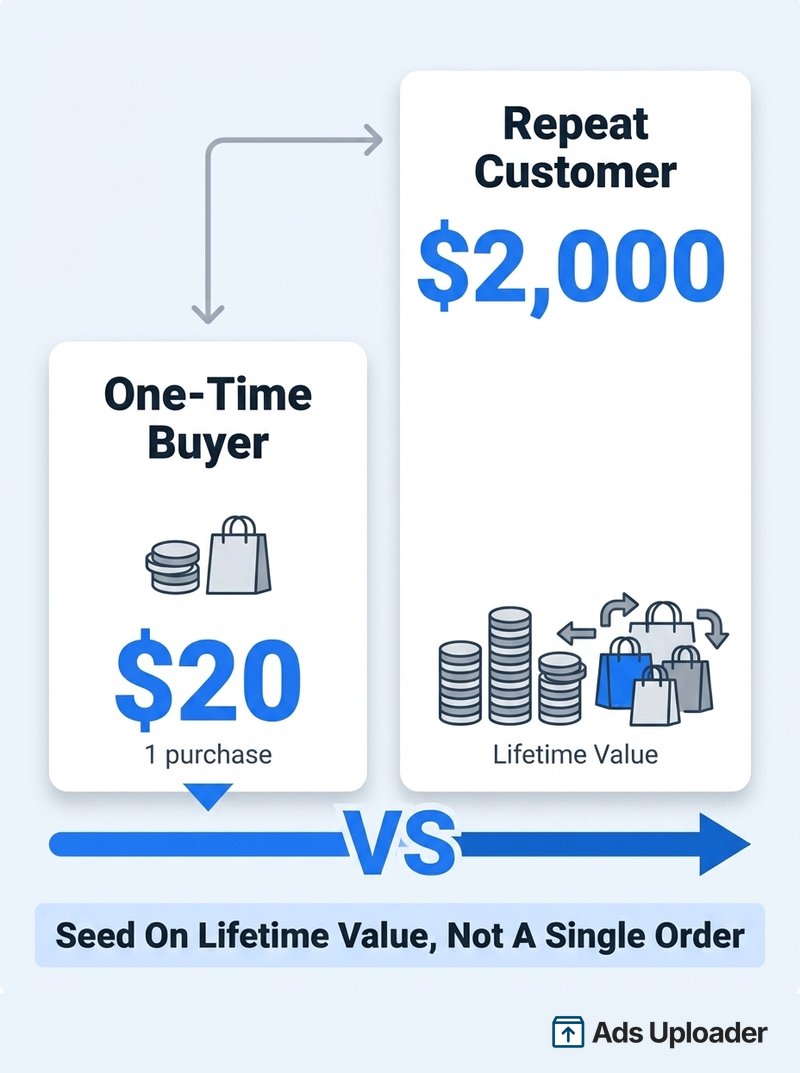
Most advertisers seed a lookalike from "everyone who purchased" and quietly throw away their best signal. To Meta, a one-time $20 buyer and a $2,000 repeat customer look identical in that list, so the lookalike chases the average of the two. Facebook value-based audiences fix that by attaching a number to each customer, so Meta knows who actually matters.
Facebook value-based audiences attach a value, usually lifetime value or order value, to each person in your seed. A value-based custom audience is that valued list. A value-based lookalike audience uses it as a seed to find new people who resemble your highest-value customers, not your average one. You can supply the value through a customer-list column or through a value-passing event such as Purchase. Seeds need at least 100 matched people, and lookalikes scale from 1% to 10% of a country.
This guide is the value layer that sits on top of a standard Facebook lookalike audience. It covers what value-based custom and lookalike audiences are, the two ways to seed them, how to choose the right value, the minimums that actually matter, and how to automate the whole thing across many accounts. Everything here is checked against Meta's current 2026 interface and Marketing API.
What Are Value-Based Audiences in Meta?
Value-based audiences come in two linked pieces. The value-based custom audience is the seed: a list of your customers where each row carries a numeric value. The value-based lookalike is what Meta builds from that seed: a new audience of people who share characteristics with your most valuable customers.
The "value" is whatever you decide it is. Meta's own customer value documentation lists several options: average order value, number of items ordered, membership expressed as 0 or 1, or customer lifetime value. You choose the definition that fits your business, then express it as a positive number. For most advertisers, lifetime value is the strongest choice, for reasons we will get to.
Why does this matter? Without a value column, Meta models your seed on generic signals and treats every customer as equal. With one, it weights the model toward the people who resemble your highest spenders. The output is a prospecting pool aimed at future high-value customers instead of any warm body who once converted.
Value-Based Custom Audience vs. Value-Based Lookalike Audience
These two terms get used interchangeably, but they are not the same thing, and the distinction changes how you work.
| Object | What it is | How you use it |
|---|---|---|
| Value-based custom audience | Your customer list with a value attached to each person | The seed. Not a targeting pool on its own; its job is to feed the lookalike |
| Value-based lookalike audience | New prospects Meta finds by weighting toward your high-value seed | The audience you actually target in an ad set |
The custom audience is the input, the lookalike is the output. The valued list is rarely something you target directly. Its whole purpose is to give Meta a weighted seed so the lookalike skews toward value. If you already know how to build a custom audience from a customer list, a value-based custom audience is the same upload with one extra column and a terms-of-service step.
The Two Ways to Seed a Value-Based Lookalike
Here is the part almost no guide states plainly: there are two ways to get value into Meta, and they suit different setups.
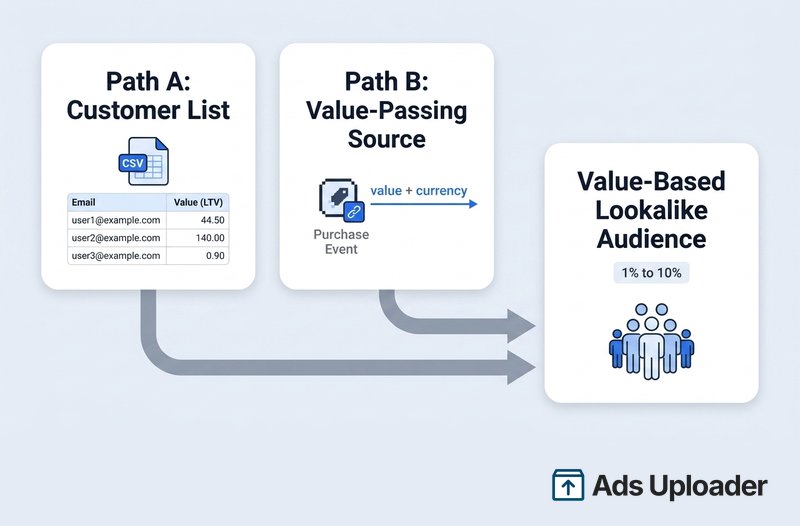
Path A: Upload a Customer List With a Value Column
This is the classic method. You export a customer list, add a value column, and upload it as a custom audience. In the flow you tell Meta the file includes customer lifetime value, accept the value-based terms, then map your columns so it knows which field is the email and which is the value.
Path A is best when your value data lives in a CRM, a warehouse, or an ecommerce platform, and you can produce a clean export. You control exactly what number each customer gets.
Path B: Point the Lookalike at a Value-Passing Event Source
Instead of a file, you can seed directly from a source that already carries transaction values: your pixel, an app event set, a product catalog, or an offline event set. In the lookalike tool you pick that source, then choose an event that carries value, usually Purchase. Meta treats the values flowing into those events as the customer value, and it will even show you the highest and lowest values plus the number of unique customers in the recent window.
Path B only works if value is actually flowing in. Your Purchase events need to send both a value and a currency, which means your Meta Pixel passes purchase value on every conversion, or your Conversions API does. Path B is the better choice when that plumbing already exists, because the audience can refresh from live data instead of a static file.
The short rule: use Path A when value lives in your database, and Path B when value already flows through your pixel or events.
How to Create a Value-Based Custom Audience
For Path A, the click path in Ads Manager is straightforward:
- Go to Audiences, then Create Audience, then Custom Audience, then Customer List.
- When asked, indicate that your list includes customer value (the option is usually labeled around customer lifetime value, or LTV).
- Accept the value-based terms of service if you have not already. This is a one-time acceptance per ad account.
- Upload your CSV, then map the columns so the value field maps to Meta's value.
- Create the audience and let it match.
The formatting rules matter more than people expect. Get them wrong and the model reads noise:
- Use positive numbers only. Meta ignores negative values, so do not use them to mark bad customers.
- Include the full range, from low to high. A list of only your top customers gives Meta nothing to contrast against, so it cannot tell an average customer from a great one.
- Use one currency throughout. Mixing dollars and euros corrupts the weighting.
- Use decimals for cents and no other punctuation. No currency symbols, no commas in the numbers.
- Include as many matchable identifiers as you can (email, phone, name). More identifiers lift your match rate, so more of the list actually gets through.
One more trap: exclude customers with a value of zero, or give them a nominal value of 1. A pile of zeros confuses the model the same way negatives do.
How to Build the Value-Based Lookalike
Once your valued seed exists, the lookalike itself is quick. Select the valued custom audience (or the value-passing source) as the lookalike source, choose a single country or region, and pick a size from 1% to 10%.
A few realities about sizing are worth internalizing. A 1% audience in the United States is the top 1% of US Meta users most similar to your seed, and the size of your seed does not change the size of that 1%. Smaller percentages are tighter and more similar; wider percentages trade similarity for reach. For value-based audiences, start at 1% and rarely go past 2% to 3%, because every extra point dilutes the high-value signal you worked to build. You can create up to six lookalikes at once if you want to test sizes.
After creation, expect Meta to take roughly 6 to 24 hours to populate the audience, though you can target it while it builds. It then refreshes every 3 to 7 days as long as an active ad set is using it. Turning on Advantage lookalike lets Meta expand the percentage when that improves results. And remember that a lookalike automatically excludes the people in its own source, so you are not paying to reach your existing seed.
Launch More. Click Less.
Upload hundreds of creatives at once, auto-match thumbnails to videos, and export directly to Meta Ads Manager.
Try Ads Uploader FreeNo credit card required • 7-day free trial
Which Value Should You Assign? Use LTV, Not Single Purchases
This is the decision that separates a value-based audience that works from one that just looks fancy. Use lifetime value, not the size of a single order.
Here is why single-purchase value misleads. One agency analysis split a customer base by gender. Men made more purchases and drove a higher return on ad spend, so on a single-order basis they looked like the better customers. But men rarely came back. Women bought less often at first yet returned far sooner and more frequently, so their lifetime value was higher. Optimize on that first-order ROAS and you would chase the lower-value group. High ROAS is not the same as a high-value customer.
If you do not have lifetime value handy, you can approximate it:
LTV ≈ Average Order Value × Purchase Frequency × Average Customer Lifespan
For example, $50 per order, twice a year, for three years is roughly $300 in lifetime value. It is a rule of thumb, not accounting, but it beats a single order amount every time. For customers who have not purchased yet, or anonymous profiles, some teams pass a predicted LTV from their analytics instead. Just keep every number positive and on the same scale.
Value for B2B and Lead Gen
Value-based audiences are not only for ecommerce. Any time you can attach a number to a person, the mechanics apply. In B2B and lead gen, you assign each lead a value based on expected revenue. A common method is deal size multiplied by close rate: if a qualified lead becomes a $10,000 sale 10% of the time, each such lead is worth about $1,000. Many teams assign a different value per funnel stage, so a lead in final negotiation outweighs a fresh inquiry. Upload that as your value column and Meta weights toward the leads most likely to turn into pipeline.
Requirements and Minimums That Actually Matter
A few numbers govern whether this works at all:
- Seed minimum: Meta needs at least 100 matched people from a single country before it will build a lookalike. That is the floor, and a floor is not a target.
- Practical floor: aim for 1,000 or more valued customers for a stable model. Under a few hundred, the weighting gets noisy and audiences become volatile.
- Data sufficiency: platforms that calculate lifetime value often require real history first. Klaviyo, for instance, only surfaces customer lifetime value once you have around 500 purchasers, 180 days of order history, and recent orders. Treat that as a useful proxy for "do I have enough to compute stable LTV."
- One country per lookalike, and the value-based terms accepted on each ad account.
If your list is global, build a separate seed per country rather than mixing them, because the 100-person minimum and the modeling both work per country.
Automating Value-Based Audiences at Scale (API and CLI)
Re-uploading a fresh CSV every month across twenty client accounts does not scale. This is where the Marketing API earns its keep, and where a browser app plus CLI workflow replaces the manual clicking.
The API path mirrors the three steps you would otherwise do by hand. First, create the seed as a value-based custom audience by setting is_value_based=1 along with a valid customer_file_source. Second, push your users to the audience with a schema that includes LOOKALIKE_VALUE, where each value is a non-negative integer or float, for example ["EMAIL", "LOOKALIKE_VALUE"]. Third, create the lookalike with subtype=LOOKALIKE and a lookalike_spec of type=custom_ratio, passing the ratio (0.01 for 1%) and the country. The seed still needs at least 100 people before the lookalike will build, and the ad account must have accepted the value-based terms or the call returns a permission error. These parameters are current in Meta's 2026 Marketing API.
If you would rather not manage flat files at all, the Conversions API can send value server-side. Each purchase fires an event with the order amount, so the valued audience updates continuously from live data instead of a periodic upload. That turns Path B into a hands-off, always-fresh seed, which is exactly what you want when you are refreshing dozens of audiences on a schedule.
When Value-Based Audiences Are Worth It
Value-based audiences shine in the lower funnel, when you are prospecting for revenue rather than traffic. They pay off most for businesses with real spread in customer value: subscription and repeat-purchase models, higher-priced products, and any catalog where the top slice of customers drives most of the profit. If every customer spends about the same, the lift is small and a standard lookalike does fine.
Set expectations on the metrics. Cost per result can look higher early, because Meta is bidding toward higher-value potential, not the cheapest immediate conversion. Judge these audiences on return on ad spend and lifetime value over weeks, not on first-click cost per acquisition. Reported results vary widely: one lead-gen case study credited a value-based audience with lifting lead-to-opportunity rate from 15% to 47% and cutting cost per opportunity by 71%, while ecommerce teams often see higher average order value at a somewhat smaller audience size. Treat any single number as a prompt to test on your own data, not a promise.
The cleanest way to know is a controlled comparison: run a 1% standard lookalike of your purchasers against a 1% value-based lookalike of the same list with values attached, same country, creative, and budget, for two to four weeks. Compare average order value and downstream value, not just cost per acquisition. If value wins, scale it and keep the seed fresh; stale lists are the most common reason these audiences quietly stop working.
Frequently Asked Questions
What Is a Value-Based Lookalike Audience on Facebook?
A value-based lookalike audience is a lookalike seeded from customers who each carry a numeric value, usually lifetime value or order value. Meta weights the model toward your highest-value customers, so it finds new prospects who resemble your best buyers rather than your average one. It remains a prospecting audience of new people, just optimized for long-term value.
Save Hours on Creative Testing
Stop uploading ads one by one. Bulk process unlimited creatives with automatic media matching and direct API publishing.
Try Ads Uploader FreeNo credit card required • 7-day free trial
What Is the Difference Between a Value-Based Custom Audience and a Value-Based Lookalike?
The value-based custom audience is the input: your customer list with a value attached to each person. The value-based lookalike is the output: the new prospecting audience Meta builds from that valued seed. The custom audience is not a fresh targeting pool on its own; its main job is to seed the lookalike.
What Is the Difference Between a 1% and a 10% Value-Based Lookalike?
The percentage is how much of a country's population Meta includes, ranked by similarity to your seed. A 1% lookalike is the tightest, most similar group and the smallest audience. A 10% lookalike is roughly ten times larger but less similar. For value-based audiences, most advertisers start at 1% and rarely go past 2% to 3%, because wider percentages dilute the high-value signal.
Which Value Should I Use, Order Value or Lifetime Value?
Use lifetime value when you have it. Single-purchase value treats a one-time buyer the same as a repeat customer, which is the exact signal value-based audiences exist to fix. If you only have first-order data, estimate LTV with average order value times purchase frequency times average lifespan, and keep every value in one currency.
How Many Customers Do I Need to Create One?
Meta's technical minimum is 100 matched people from a single country in the seed. That is a floor, not a target. For a stable signal, aim for 1,000 or more valued customers; under a few hundred the model tends to be noisy. Platforms that compute lifetime value often need around 500 purchasers and several months of history first.
Do Value-Based Audiences Work for Lead Gen and B2B?
Yes. Any time you can attach a number to a person, you can use value-based audiences. In B2B and lead gen you assign each lead a value based on expected revenue, often deal size multiplied by close rate, or a value per funnel stage. Meta then weights toward people who resemble your highest-value leads.
How Is a Value-Based Lookalike Different From Retargeting or a Standard Lookalike?
Retargeting reaches the exact people you already know, such as recent visitors or buyers. A standard lookalike finds new people similar to your seed but treats a $10 buyer and a $1,000 buyer equally. A value-based lookalike is still a new-prospect audience, but it biases the model toward people who resemble your most valuable customers.
The Bottom Line
Value-based audiences are a small change with a large effect: attach a number to each customer so Meta chases your best customers instead of your average one. Build a value-based custom audience as the valued seed, then a value-based lookalike as the prospecting output. Choose your seed path by where the value lives, your database or your pixel. Use lifetime value, not single purchases. Mind the 100-person floor and aim well above it, judge performance on return over weeks rather than first-click cost, and automate the refresh through the Marketing API or Conversions API once it works. Do that and your prospecting stops modeling the crowd and starts modeling your most valuable customers.
For the official mechanics and current parameters, see Meta's documentation on the customer value column, the help center guide to creating a value-based lookalike audience, and the Meta for Developers value-based lookalikes reference.
