White label Facebook ads are Meta advertising services an agency sells under its own brand while a third party, software, or a standardized internal process handles the delivery. The client never sees the supplier. Agencies make money on the markup between what they pay wholesale, commonly $199 to $499 per account each month for full fulfillment, and what they charge the client. It lets an agency offer paid social without hiring specialists, provided the work is priced and the ad account ownership is set up correctly.
White-label Facebook ads are how a lot of agencies sell Meta advertising without building a paid-social team. You sell the service under your brand, someone else (or a tool, or a tight standardized process) handles delivery, and the gap between what you pay wholesale and what you charge the client is your profit.
The complication is that "white label Facebook ads" means at least four different things, the pricing is mostly behind "book a call," and a few details that decide whether you actually make money (Meta's account-ownership rules, the learning phase, churn) tend to stay quiet until they cost you.
This guide covers the four models, what each really costs, the markup math, and the ownership rules that protect your margin. It also answers the question the seller pages skip: for this specific client, should you white-label at all, or are you better off running the ads yourself or referring them out?
Which Model Fits You (Quick Version)
Before the detail, the short answer:
- No paid-social skill, need delivery now: buy a fulfillment service (~$199–$499 per account monthly wholesale).
- You have operators; the bottleneck is reporting or scale: license white-label software.
- You want a branded offer to sell fast, not media depth: resell a SaaS stack.
- You have steady volume and want the best margin: run delivery yourself, standardized and automated with tooling like Ads Uploader.
But before you shop suppliers, ask the prior question most agencies skip: should this client's ads be white-labeled at all? Often the answer is no, and that decision protects your margin and your relationship more than any provider choice. The rest of this guide builds to it.
What Are White Label Facebook Ads?
White label Facebook ads (also called private label or reseller Facebook ads) are any arrangement where your agency sells Meta advertising under its own brand while someone, or something, else does the work. The client sees your logo on every report, login, and email and never learns another company was involved. The catch is that what gets white labeled differs completely between models: sometimes it is a team of people, sometimes a dashboard, sometimes a whole rebrandable software stack. Those have very different economics, so pin down the model before you shortlist a provider.
The 4 Models of White Label Facebook Ads
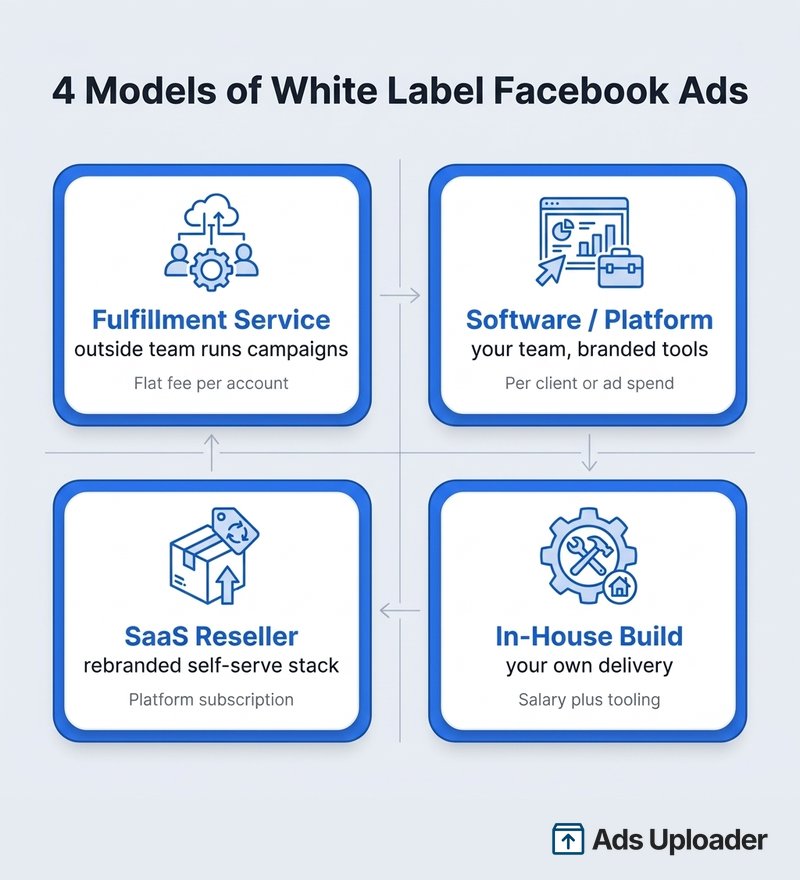
There are four distinct operating models hiding under one phrase.
1. White-label fulfillment service. An outside team plans, builds, optimizes, and reports on Meta campaigns while staying invisible to your client. You own the relationship; they do the media buying. This is the model most people mean when they say "white label Facebook ads." Examples in the market include Agency Elevation, Semify, White Shark Media, InvisiblePPC, DashClicks, and Clickx.
2. White-label software/platform. Your team still does the strategy and decisions, but you license tools for reporting, automation, launch, optimization, or cross-account control, all branded to you. This replaces some labor but never all of it. Reporting and automation platforms like AgencyAnalytics, Birch, Madgicx, Adzooma, Scalify, and Socioh sit here.
3. White-label SaaS reseller. You primarily resell a platform, dashboard, or self-serve ad environment under your brand, sometimes bundled with light support. DashClicks and Vendasta straddle this layer because they are explicitly rebrandable software ecosystems on top of fulfillment.
4. In-house build. You run delivery yourself, with or without your own hires. Not "white label" in the strict sense, but it is the alternative every honest comparison has to include, and for most add-on clients it is the right answer.
| Model | Who does the work | Cost basis | Best for |
|---|---|---|---|
| Fulfillment service | Provider's team | Flat fee per account/month | No in-house paid-social skill; need capacity now |
| Software/platform | Your team | Per client, ad spend, or revenue | You have operators; constraint is throughput/reporting |
| SaaS reseller | Mostly the client (self-serve) | Platform subscription | Packaging and go-to-market, not media depth |
| In-house build | You / your hire(s) | Salary + tooling | Most add-on clients; best margin and control |
The single most useful question across all four: does this remove the need for strategic labor, creative judgment, QA, and client communication, or does it just accelerate it? A fulfillment partner removes it. A software subscription does not.
Launch More. Click Less.
Upload hundreds of creatives at once, auto-match thumbnails to videos, and export directly to Meta Ads Manager.
Try Ads Uploader FreeNo credit card required • 7-day free trial
How White Label Facebook Ads Management Actually Works
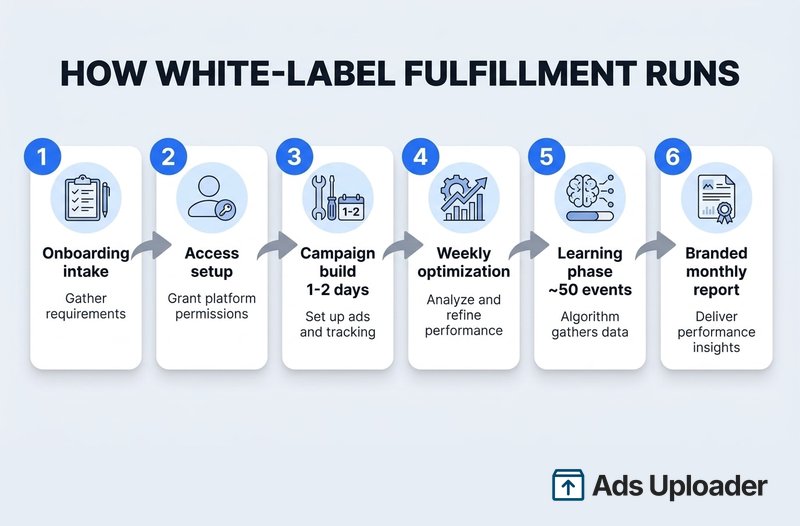
The fulfillment model follows a fairly standard pipeline. It starts with an onboarding intake form for each client, then access setup, then the campaign build. Competent teams can have a new build live in a day or two once they have assets and access. From there, accounts are reviewed and optimized weekly: new ads, ad sets, and audiences created and tested over time, with a white-labeled report sent at month end under your logo.
Good fulfillment is rarely one media buyer on the back end. The stronger partners field a small pod: a strategist, a tracking/web specialist, a launcher, an optimizer, and a reporting layer. Communication runs through Slack, a portal, or email, and the provider should never contact your client directly. Response time tends to be a real differentiator between providers.
The part agencies most underestimate is the Meta learning phase. An ad set typically needs around 50 optimization events after the last significant edit before it exits learning, and major edits push it back in. Any provider promising miracles in the first seven days is either oversimplifying or relying on pre-existing account data. Realistically, the first one to three weeks are for clean setup, technical validation, early creative testing, and signal collection.
One 2026 reality check: Meta's own materials now center Advantage+ and AI optimization (Andromeda ranking is credited with 8% higher ad quality, and streamlined Advantage+ sales setup with an average 9% lower CPA). Fulfillment value is moving away from hidden targeting tricks and toward creative throughput, offer clarity, landing pages, signal quality, and testing discipline. Judge partners on those, not on how many micro-settings they touch each week.
What White Label Facebook Ads Cost (and the Markup Math)
Wholesale service pricing is usually a flat fee per account with volume discounts. Software pricing scales by clients, ad spend, or revenue. The difference between wholesale cost and your client price is the whole profit model, so get precise about both.
The clearest publicly published wholesale fulfillment schedule belongs to Agency Elevation (verified May 2026), a useful neutral anchor even if you buy elsewhere:
| Accounts | Wholesale price/account/month |
|---|---|
| 1 | $499 |
| 2–4 | $399 |
| 5–14 | $299 |
| 15–44 | $199 |
| 45+ | Custom |
Many other named providers (Semify, White Shark Media, InvisiblePPC, DashClicks) are effectively quote-only for Meta fulfillment, with no public Facebook line-item price I could verify. Treat unpublished pricing as exactly that, not a hidden bargain. Software is more transparent: branded reporting (AgencyAnalytics) starts around $20 per client per month; automation platforms (Birch, Madgicx, Adzooma) run from roughly $49 to a few hundred per month; enterprise ecommerce creative platforms (Socioh) start near $1,100 per month and do not run ads for you at all.
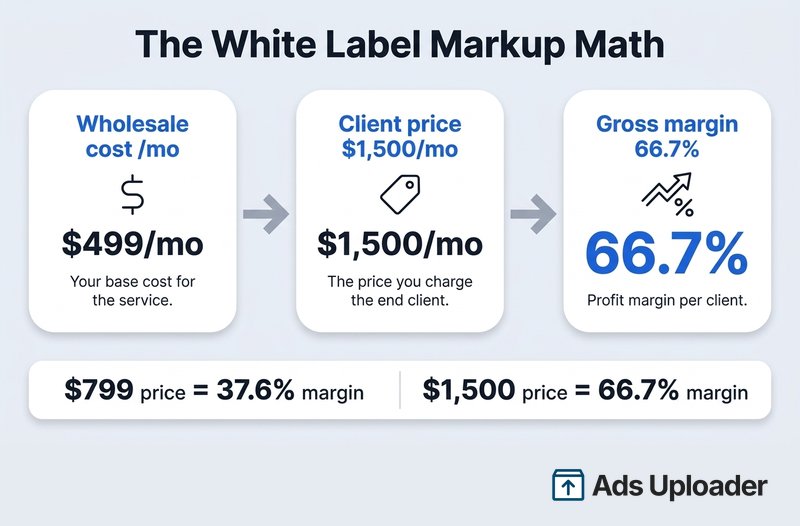
Now the markup math. Using the $499 wholesale tier as a reference (modeled examples, not market norms):
| Wholesale cost | Your client price | Gross profit | Gross margin |
|---|---|---|---|
| $499 | $800 | $301 | 37.6% |
| $499 | $1,250 | $751 | 60.1% |
| $499 | $1,500 | $1,001 | 66.7% |
| $399 | $1,500 | $1,101 | 73.4% |
One realistic scenario, end to end. Sign five clients at $1,500/month and that is $7,500 in monthly revenue. At Agency Elevation's 5–14 tier of $299, wholesale fulfillment costs 5 × $299 = $1,495, leaving roughly $6,000 in service-level gross profit (about 80%). That is not take-home. Out of it come the things the wholesale fee does not cover: your time selling and retaining those clients, account management and QA on top of the supplier, a reporting tool, the revisions clients expect you to absorb, and the month a client churns before the next one signs. Plan on half to two-thirds of that gross surviving to real contribution. The takeaway: white-label paid social is a healthy line only if you price it like a specialist service, not a cheap add-on. A 2025 benchmark of 300+ seven- and eight-figure agencies put overall profit margins around 18–22% and 25–32% respectively, so a "fat" service-level line still gets eaten by sales, PM, reporting, and churn.
The Access and Ownership Rules That Protect Your Margin
These operational rules decide whether a white-label arrangement stays clean and profitable, especially when a client eventually leaves.
Ad account ownership is mostly one-directional. Meta is explicit: once an ad account is created inside a business portfolio, it cannot be transferred to another portfolio. If your agency (or your white-label supplier) creates the client's ad account inside its portfolio, the client can be granted access later, but the ownership container does not move at offboarding. The safest commercial structure is client-owned ad account, client-owned pixel/dataset, client-owned domain, and client-owned Page, with the agency and supplier holding partner access rather than ownership.
Partner-to-partner access is not free-for-all. You can share assets with partners only if you have full control of the owning business portfolio, and ad accounts can only be shared to an authorized business portfolio. So Agency A with mere shared access to a client's account should not assume it can cleanly re-share that account to Agency B. The clean path is for the asset owner, usually the client, to authorize the second partner directly, or to add specific people to the ad account under Ad account settings. That is the real answer to the "Facebook won't let partners grant access to other partners" line in vendor copy: it is an asset-owner action, not a partner-chain action. Get this wrong and you can trigger account-sharing restrictions, which is a fast path to access problems.
History is only partly portable. You can copy ads between accounts, duplicate campaigns, and export and re-import ads in bulk, so creative and structure travel fine. The original account's native performance history does not. Plan offboarding around "creatives and builds are portable; account continuity is not."
Brand risk runs one way. When delivery is poor, your client blames you, not the invisible partner. You own the conversation, the relationship, and the reputation. That is the trade you make for the margin, and the reason the next decision matters more than which provider you pick.
Should You White-Label at All?
Most articles on this topic jump straight to "which provider." The more important question is the one the sellers skip: for this specific client, should the ads be white-labeled at all?
Start with the part that is genuinely hard. You have to be confident a third party will do good work for your client, and that is difficult to judge from a sales call. It is hard enough in the normal agency world. Clients cycle through agencies over their lifetime, and one a client stays with for several years is the exception. White-labeling stacks another layer of that same risk onto a supplier you know even less, with your name on everything they do.
And the supplier almost never understands the client's business as well as you do. There is no value in running Meta ads for the sake of running them. Every campaign has to be intentional and tied to the client's actual goals, which is exactly the judgment an outside fulfillment team is least equipped to bring. Be honest about their role: if they are mostly launching campaigns from a decision tree because you do not have time, the real bottleneck is launch speed, not strategy, and a whole agency is an expensive way to solve a speed problem.
The economics reinforce it. A US Paid Social Manager runs roughly $78,000/year, and outsourcing only loses to in-house once you have low-teens to low-twenties stable accounts. But that math assumes the work is slow. Mostly it is not strategy. It is the repetitive build: uploading creatives, matching thumbnails, applying naming conventions, and launching the same structure across accounts. Remove that and one person covers a lot of clients with no agency layer at all.
So split the decision by how central the ads are to the relationship.
If Meta ads are a minor add-on to a bigger relationship (you mainly do their site, SEO, or social and "also run their Facebook ads"), do not bolt on an outside team you then have to manage and trust. Run it yourself and make it fast with the right tooling, or drop the line. Ads Uploader exists precisely so one person can turn a batch of creatives into launched, reviewed Meta ads in minutes, which is the only reason most agencies wanted to outsource the add-on in the first place. For a small client, that is the entire job: done in-house, at full margin, with nobody else's name on it.
If Meta ads are core to that client's results, white-labeling blindly is the single riskiest choice you can make, because when performance slips the blame lands on you, not the invisible partner, and it can drag your other contracts with that client down with it. Either commit to owning it properly in-house, or refer the client to a specialist you have genuinely vetted and let that specialist own the ads directly.
White-label can still be the right call in one narrow case: the provider is genuinely well established, you know their processes, and you have seen their work hold up over time. Short of that bar, putting a stranger in front of your client is rarely worth the easy-revenue story you were sold.
Save Hours on Creative Testing
Stop uploading ads one by one. Bulk process unlimited creatives with automatic media matching and direct API publishing.
Try Ads Uploader FreeNo credit card required • 7-day free trial
How to Vet a White-Label Partner
If you do outsource (usually the core-client case where you cannot build in-house and choose a partner over a referral), the provider's quality is your brand's quality. Before signing, get clear answers on:
- Team shape. A real pod (strategist, tracker, launcher, optimizer, reporting) or one overloaded media buyer?
- Included vs extra. "We manage your Meta ads" can exclude design, video, UGC, or landing pages. Get scope and add-on prices in writing.
- Communication and SLA. Slack or portal, same time zone, a stated response time.
- Invisibility in writing. The contract should state work is branded to you and they never contact your client.
- Access model. They accept access into a client-owned account, not the reverse.
- Contract terms. Month-to-month over lock-in; confirm whether fees are prepaid or refundable.
Judge them on creative and signal quality, not on how many micro-settings they tweak.
How to Start Reselling Facebook Ads Under Your Brand
If you keep it in-house (the right move for most add-on clients), you do not need a team. You need a model, a price, and a clean account structure:
1. Price it as a specialist service first. Decide the client price on value, not cost-plus. Pricing low to look competitive is how agencies end up sub-40% margins.
2. Set the account structure up correctly, once. The client owns the ad account, pixel/dataset, domain, and Page. You get partner access. Never create the client's ad account inside your own portfolio; get this right at onboarding and offboarding is a clean revoke instead of a fight.
3. Build a repeatable onboarding intake. One form per client: offer, audience, assets, tracking, access. A vague intake is the biggest cause of slow launches.
4. Standardize and automate the build. Same structure, same naming, same weekly cadence, same branded report. The repetitive launch work is the actual bottleneck. This is exactly what Ads Uploader is built for: bulk launching a folder of creatives into reviewed, paused ads across accounts in minutes, without a media buyer in Ads Manager all day. It is what makes the in-house path cheaper than any wholesale fee.
5. Own the client conversation. Always you. You walk into every results call with the data and the plan, and the client never sees a back end.
Frequently Asked Questions
What is white label Facebook ads management? An arrangement where another company fulfills Meta campaign work behind the scenes while the client experiences the service entirely under your brand. In 2026 it can mean done-for-you labor, white-label reporting/automation software, a reseller SaaS stack, or a mix.
Should I white-label my client's Facebook ads or run them myself? Split it by how central the ads are to the relationship. A minor add-on: run it yourself with fast tooling or drop the line rather than adding an agency you must manage and trust. Core to the client: own it properly in-house or refer to a specialist you have vetted. Blind white-labeling rarely beats either.
How much do white label Facebook ads cost, and what's a typical markup? The cleanest public wholesale schedule is roughly $199–$499 per account/month by volume. Platforms range from about $20/client to a few hundred per month. Modeled service-level gross margins land around 40–75% depending on retail price and bundle. That is a modeled range, not a universal benchmark.
Will my client know I'm outsourcing their Facebook ads? Not necessarily. Reputable providers brand everything to you and never contact your client. The real exposure is account-ownership mistakes, non-branded URLs, a vendor emailing the client, or delivery that feels disconnected from your promises.
Who owns the ad account and data? The business portfolio that owns the asset. An ad account created in one portfolio cannot be transferred to another. Standard practice: the client owns the core assets; the agency and any supplier receive access.
Service or software: which should I buy? Service if you lack operators and need capacity now. Software if you have operators and your constraint is throughput, automation, or reporting. The mistake is buying software when you need people, or labor when your bottleneck is workflow.
Can I deliver Facebook ads under my own brand without hiring a team? Yes. The build work, not the strategy, is the real bottleneck. Tooling that automates uploads, thumbnails, naming, and launches lets one person run branded Meta ads across many clients without an outside agency layer.
The Bottom Line
White label Facebook ads are sold as easy revenue. The honest version is that you are putting your client relationship in a stranger's hands, under your name, on work they understand less well than you do.
- Fulfillment service: outside team, ~$199–$499/account/month wholesale; only safe when you deeply know the provider.
- Software/platform: accelerates your team, never replaces judgment.
- SaaS reseller: fastest branded offer, weakest media depth.
- In-house / your own delivery: best margin and control, and faster than it used to be.
The real lever is not which provider. It is whether to white-label this client at all. If Meta ads are a minor add-on, run them yourself or drop the line; an agency layer you have to manage and trust is rarely worth it on a small account. If ads are core to the client, own them properly or refer to a specialist you trust; never hand a stranger the account your relationship depends on.
The reason in-house is now the default for most add-on clients is simple: the work that pushed agencies to outsource was never the strategy, it was the launch grind. Ads Uploader removes that grind, turning batches of creatives into launched, reviewed Meta ads in minutes. Run the ads under your brand, keep the margin, and keep the relationship in your own hands. Start there before you ever shop a white-label provider.
