Facebook ad fatigue is performance decay that happens when an audience has seen the same creative too many times, so response drops and cost per result climbs. Meta detects it through cost-per-result thresholds: "Creative limited" when cost per result exceeds past ads but stays under 2x, "Creative fatigue" when it reaches 2x or more. Meta's research shows click likelihood decays roughly as (N+1)^-0.43, about a 45% drop by the fourth exposure. Diversifying creative, not refreshing on a calendar, is the evidence-based fix.
Here is a campaign every media buyer recognises. It prints money for three weeks. The cost per purchase is the best you have seen all year, so you scale the budget. Then, quietly, it breaks. No error, no rejection, no policy flag, just a slow bleed where every result costs a little more than the last.
That is Facebook ad fatigue, and it is one of the most expensive problems in Meta advertising because it never announces itself. The spend keeps flowing while the return quietly erodes. The useful part is that Meta has published the data, run the experiments, and shipped in-product definitions for exactly this. This guide uses that primary-source material, plus the current expert consensus, to give you the real mechanics, a framework for telling fatigue apart from its lookalikes, and an evidence-based fix.
What Is Facebook Ad Fatigue?
Facebook ad fatigue is the decline in ad performance that occurs when the same people see the same creative repeatedly. Meta's precise term for the mechanism is creative fatigue: an audience has seen a given image or video enough times that responsiveness drops, results get more expensive, and Meta surfaces a warning in the Delivery column of Ads Manager.
Meta defines two in-product statuses, and the difference is purely about cost per result:
- Creative limited: cost per result is higher than your past ads, but less than twice as high.
- Creative fatigue: cost per result is greater than or equal to twice your past performance.
Those thresholds, documented in Meta's creative fatigue recommendations Help Center article, have remained materially consistent into 2026. Meta can also warn you before you publish if it predicts fatigue within the first 7 days of a campaign, though that pre-launch prediction only applies to ad sets with a single creative and excludes Advantage+ catalog ads, dynamic creative, and Advantage+ app campaigns.
There is a feedback loop underneath the status label. As people stop engaging, Meta's relevance signals weaken, delivery narrows toward cheaper and less engaged inventory, and performance erodes further. The status is the symptom. The repeated exposure is the cause.
Ad Fatigue vs Creative Fatigue vs Audience Fatigue
These terms get used interchangeably, but the distinction is the single most useful thing in this article because it determines the fix.
| Term | What's worn out | The fix |
|---|---|---|
| Ad fatigue | Umbrella term for the broad slowdown | Diagnose which type below |
| Creative fatigue | The specific message or asset | New, genuinely different creative |
| Audience (saturation) fatigue | The reachable pool itself | Broaden or refresh the audience |
| Creative similarity | Your whole creative pool looks alike | Add truly differentiated concepts |
Meta itself draws the last distinction explicitly. In Account Insights, creative fatigue means repeated exposure to the same creative, while creative similarity means you have a pool of creatives that look too alike to function as real variation. You can have a dozen "different" ads and still fatigue an audience if they are all the same hook in slightly different fonts.
If new creative inside the same audience restores performance, it was creative fatigue. If performance only recovers when you reach a fresh audience, it was saturation, and the fix lives in your audience targeting. Hold onto that test, because it becomes the spine of the decision framework later.
What the Data Actually Says (Meta's Own Research)
Meta published a detailed study, "Creative Fatigue," from the Analytics at Meta team (November 2023), and the numbers are worth knowing precisely.
Meta measured exposure at the user-by-creative level over a 30-day window, not at the campaign or ad-set level. In its direct-response sample, the average impression went to someone who had already seen that same creative 4.2 times in the prior 30 days, and 19% of impressions went to people who had seen the creative five or more times. Repetition is not an edge case; it is the default state of delivery.
The response decay follows a consistent shape. Click likelihood falls approximately as (N+1)^-0.43, where N is the number of prior exposures (Meta uses a more conservative -0.4 in its simplified fatigue-level metric). In plain terms: by the fourth exposure, conversion likelihood is down roughly 45%, and it keeps dropping after that.
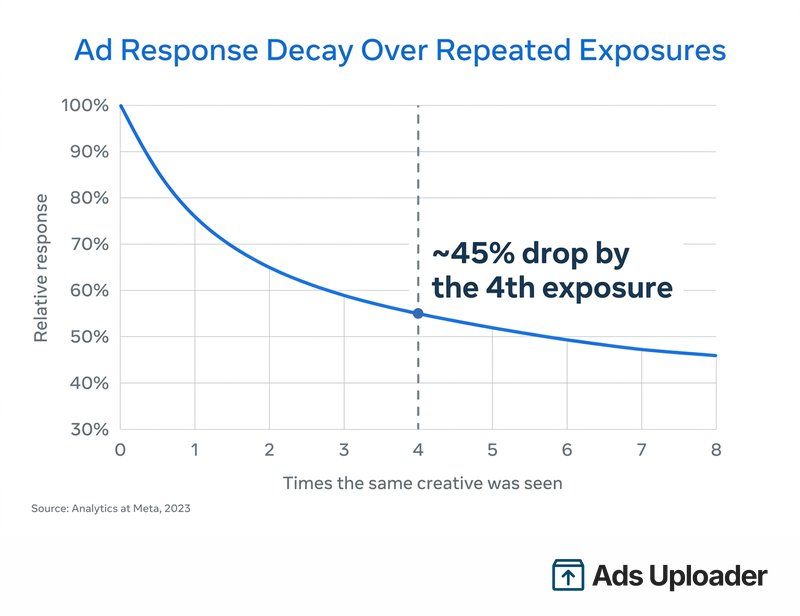
Two findings matter more than the headline percentage:
- There is no "wear-in" period for direct response. The old belief that an ad needs to "warm up" before it fatigues did not hold in Meta's direct-response data. Performance degraded from the start. (Brand objectives may behave differently, since upper-funnel goals are not the same as immediate conversions.)
- Adding fresh creative causes recovery. In a randomized experiment across roughly 26,000 observations, Meta added new ads to fatigued ad sets and saw a dose-dependent improvement: about an 8% average lift in conversion rate among higher-fatigue cases. This is causal evidence, not correlation. Diversification works.
One common assumption is worth correcting. There is no public Meta evidence that video inherently fatigues slower than static. The effect held with similar magnitude across static, video, and carousel. Format choice is a creative decision, not a fatigue exemption.
Why Frequency Is a Misleading Signal
Frequency is the metric everyone reaches for, and it is the one Meta's own research implicitly warns against using alone. The reason is structural. Frequency is an average number of impressions per person, reported at the ad, ad set, or campaign level. But fatigue happens at the creative level, over a time window. A frequency of 3 means something completely different depending on whether it is three views in seven days, three in thirty days, or three spread across five distinct creative variations.
This is why the published thresholds contradict each other. Meta's Instagram creative guidance suggests aiming for 2-3 impressions per person over 7 days. Some agencies flag 2.5-3 as a prospecting warning zone and tolerate 5-10 in retargeting. Others put the danger zone at 4-5+. Jon Loomer argues advertisers should not obsess over any fixed number at all. They are not all wrong; they are measuring different windows and audience types.
The practical reconciliation: cold traffic fatigues sooner than retargeting, and the time window matters as much as the absolute number. Use frequency as a warning light that prompts you to look at cost per result and creative-level exposure, never as a verdict on its own.
Launch More. Click Less.
Upload hundreds of creatives at once, auto-match thumbnails to videos, and export directly to Meta Ads Manager.
Try Ads Uploader FreeNo credit card required • 7-day free trial
How to Spot Facebook Ad Fatigue Early
The earliest reliable signal is not a single metric. It is a pattern. Watch for these moving together:
- Rising cost per result while budget and targeting are unchanged
- A slow CTR decline against flat or rising impressions
- CPC creeping up while conversion rate holds relatively steady
- Falling engagement (likes, comments, saves) and rising negative feedback ("hide ad," "seen this too much")
- Shortening video retention or delivery concentrating into one placement or segment
One widely repeated heuristic is worth correcting. "CPA up but CTR steady equals creative fatigue" is not well supported. If CTR is holding but cost per result is rising, the more likely culprits are auction competition, a landing-page or checkout problem, measurement gaps, or a weak offer, not the creative. The cleaner creative-fatigue fingerprint is CTR drifting down, CPC rising, and conversion rate staying relatively stable, because repeated exposure hits click probability first.
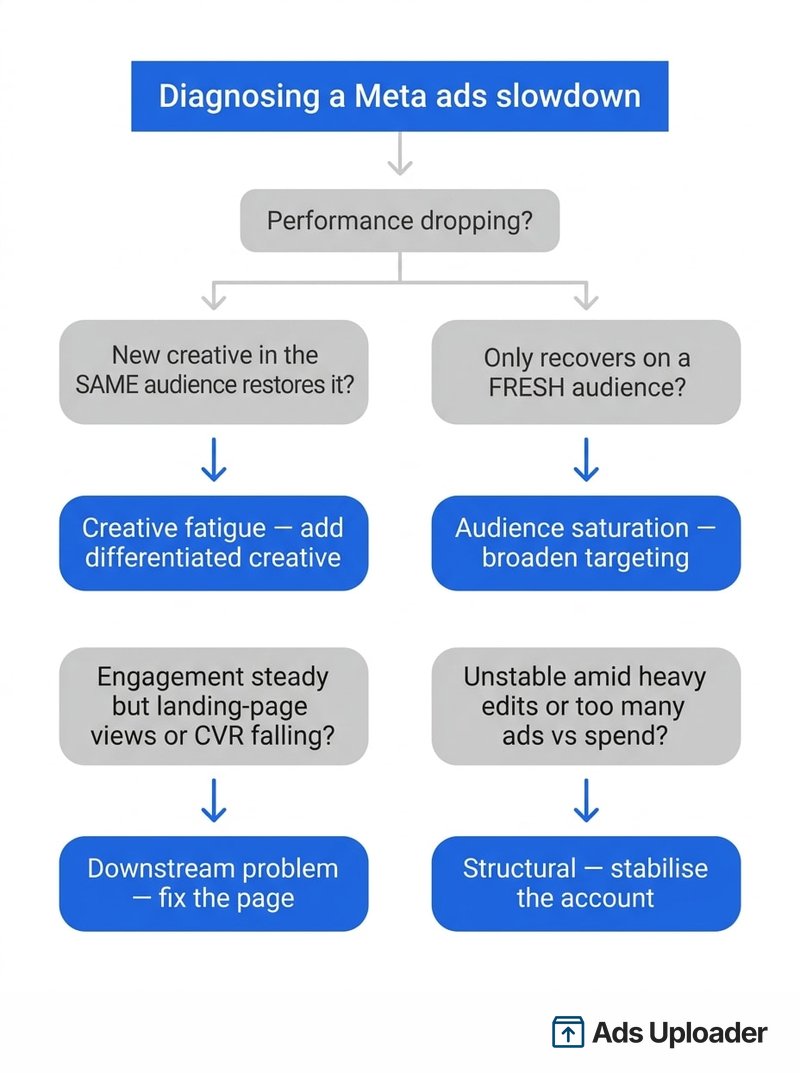
Run the diagnosis in this order:
- Is Meta flagging Creative limited or Creative fatigue, or is unique CTR falling while exposure metrics worsen? Start with creative.
- Does new creative in the same audience restore performance? It was creative fatigue.
- Does performance only recover when you broaden or refresh the audience? It was audience saturation.
- Is ad engagement steady but landing-page-view rate, site speed, or on-site conversion deteriorating? It is a downstream problem, not a creative one. If you suspect this, split-test the landing page before touching the ads. It is also worth confirming your measurement is clean, since shifts in how conversions are attributed can look like fatigue when they are not.
- Is performance unstable amid heavy account edits, duplicated structures, or excessive ad volume relative to spend? That is structural inefficiency masquerading as fatigue.
That third branch -- change the creative without changing the audience -- turns a vague argument into a falsifiable test. It is the most valuable habit you can build.
How to Fix Facebook Ad Fatigue
Diversify creative, don't just "refresh on a cadence"
Meta's own experiment showed the single most reliable fix: add meaningfully different creative to the fatigued ad set. Not a font change or a recolored background, but a new hook, a new angle, a new visual treatment, a new message. The old direct-response instinct to "let it run and refresh next week" is exactly what Meta's no-wear-in finding contradicts.
This is also where the modern strategy diverges sharply from 2021 playbooks. Jon Loomer's current position is that not all ads fatigue, that the old six-ads-per-ad-set ceiling is gone, and that you should stop hunting for a single "winning ad" and instead build ad sets from many ads that contribute to aggregate performance. The defensible editorial line, balancing both camps: avoid blind calendar-based refresh mandates, but maintain an intentional testing pipeline. Pilothouse's 3-3-3 approach (three funnel levels, three angles, three formats) is one practical way to keep non-trivial variation flowing without tying refreshes to the calendar.
Build genuinely different variations
Diversification is not volume for its own sake; it is variety that actually changes what a person experiences. Concretely:
- Vary the angle and hook, not just the visual. A new mechanism or problem framing reignites attention far more than a new color.
- Use multiple primary text and headline variations (Meta supports up to five of each).
- Provide proper aspect ratios per placement so the same idea renders well everywhere, and treat ad copy as a tested variable, not an afterthought.
- Rotate formats: a static concept becomes a carousel or a short video that reaches people differently.
- Accept Advantage+ creative variations and AI backgrounds where they genuinely add differentiation. Meta says creative differentiation has driven 32% increased efficiency and 9% incremental reach in its testing.
Save Hours on Creative Testing
Stop uploading ads one by one. Bulk process unlimited creatives with automatic media matching and direct API publishing.
Try Ads Uploader FreeNo credit card required • 7-day free trial
Broaden audiences, placements, and objectives
When saturation is part of the problem, more creative will not fully fix it. Broader audiences give Meta room to find responsive people and can lower cost per result. Restricted audiences, restricted placements, and large budgets pushed into small pools are the classic accelerants of fatigue. A Sweat Pants Agency case study on Tearribles reported a 52% revenue lift in three weeks, a 24% CPA drop, and 31% better ROAS after shifting to clearer problem-solution creative and simplifying prospecting audiences, with creative and audience structure working together.
Duplicate strategically, but don't lead with it
Duplicating an ad set re-enters the learning phase and can redistribute delivery, which sometimes buys a temporary reprieve. But it does not solve repeated exposure the way new creative does. Significant edits and duplication can destabilize learning, so treat duplication as a tactical tool when the creative is still strong but delivery has plateaued, not as a reset button you mash every time results dip.
The Real Bottleneck: Shipping Creative Volume
This is where the money actually leaks. The data is unambiguous that the fix is more differentiated creative, shipped continuously. The binding constraint is producing, naming, launching, and reading that volume fast enough.
The need scales with spend. Meta's own ad-limits-per-Page documentation tiers capacity by spend: pages under $100K in their highest month are capped at 250 ads, under $1M at 1,000, under $10M at 5,000. Meta built the Andromeda retrieval engine specifically to handle the "exponential growth" of ad creatives, and reports more than a million advertisers generating 15M+ ads a month with its AI tools. To be precise: Meta does not claim Andromeda makes fatigue happen faster (that is a practitioner inference), but it does mean feeding the system differentiated inputs matters more than ever.
The strategic awareness is the easy part now. The throughput is the hard part. Building twenty genuinely different variations across several ad sets, naming them so the data stays auditable, and launching them without losing an afternoon in Ads Manager is the work that actually determines whether you stay ahead of fatigue. This is exactly the problem a bulk ad launch tool exists to solve, and why a disciplined ad naming convention stops a high-volume creative library from becoming unreadable. Solve the production bottleneck and "diversify continuously" stops being advice you nod at and starts being something you actually do.
Getting Ahead of Facebook Ad Fatigue
Here is what to take away:
- Fatigue is repeated-exposure decay, not a frequency number. Meta's data shows roughly a 45% drop in conversion likelihood by the fourth exposure, with no wear-in period for direct response.
- Diagnose before you fix. New creative in the same audience that restores performance proves creative fatigue; recovery only on a fresh audience proves saturation; steady CTR with rising cost points downstream.
- Diversify, don't calendar-refresh. The evidence-based fix is genuinely different creative added continuously, not a weekly ritual.
- The bottleneck is execution. Knowing you need more variation is no longer the hard part; shipping it fast and keeping it organized is.
Facebook ad fatigue is not destiny. It is mostly the product of restricted audiences, thin creative variety, and over-reliance on frequency as a single number, all of which you control. Diagnose the type, let Meta's decay data set your refresh timing, and build a creative pipeline you can actually sustain.
If you are running dozens of ad sets and the real blocker is getting diversified creative live fast enough, Ads Uploader handles bulk ad creation and launching at scale, so refreshing creative before fatigue bites becomes a routine you can keep, not a fire drill you dread.
